Sometimes Less Really Is More
A common mistake among cannabis growers is assuming that heavier feeding automatically leads to bigger plants and larger, denser harvests. Cannabis doesn’t work that way. Once nutrient levels climb beyond what the root zone can handle, fertilizers stop helping and start causing stress, dehydration, salt buildup, and nutrient lockout.
What Causes Nutrient Toxicity in Cannabis?
Nutrient toxicity occurs when cannabis plants receive more mineral salts than the roots can absorb efficiently. In most grows, that creates three connected problems:
- Salt accumulation in the substrate
- Excessively high EC levels
- Root-zone lockout
EC (electrical conductivity) measures the amount of dissolved mineral salts in irrigation water or nutrient solution. The more fertilizer added, the higher the EC rises. But a high EC does not automatically mean the plant is feeding more aggressively. Often, it means the opposite: salts have built up around the roots to the point where water and nutrient uptake become difficult.
At that stage, fertilizer stops acting like nutrition and starts acting like a barrier.
Excess levels of one nutrient can also interfere with the uptake of others:
- Too much potassium (K) commonly interferes with the absorption of calcium (Ca) and magnesium (Mg).
- Excess phosphorus (P) often triggers secondary lockouts involving calcium, iron, zinc, and magnesium.
- Too much nitrogen can cause severe toxicity and delay flower ripening.
That’s why overfed cannabis plants often show symptoms that look like nutrient deficiencies even when nutrients are present in excess. The issue is availability. The roots simply can’t access them properly.
Signs of Overfertilization in Cannabis Plants
Cannabis plants usually send clear signals when nutrient levels become excessive.
Burnt Leaf Tips: Classic Nutrient Burn
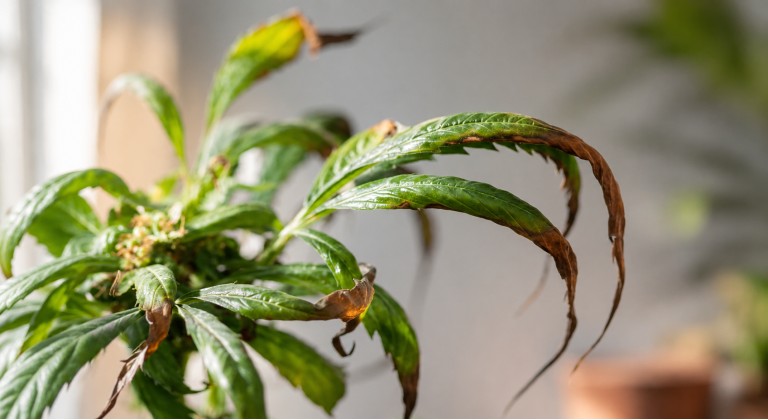
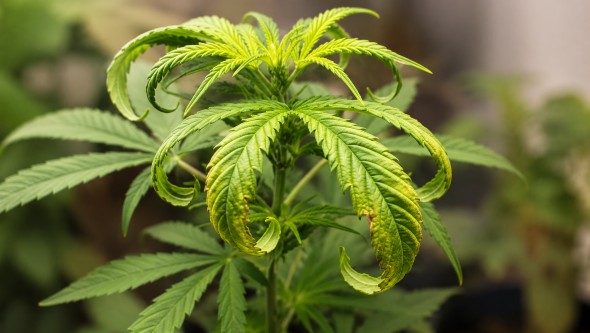
The most recognizable symptom is yellow, brown, or crispy leaf tips. It usually starts subtly with a slightly burnt edge at the tip of the leaf. If overfeeding continues, the damage spreads along the margins and eventually kills surrounding tissue.
Timing matters. If burnt tips appear shortly after increasing nutrient strength, adding PK boosters, combining multiple fertilizers, or feeding with high EC solution, overfertilization becomes the most likely explanation.
Dark Green Leaves and “Clawing”: Nitrogen Toxicity
Nitrogen toxicity has a very recognizable appearance:
- Extremely dark green leaves
- Glossy or waxy foliage
- Leaf tips curling downward
- “Claw-shaped” leaves
- Rigid, uneven growth
This problem is especially common during the vegetative stage, although it can also appear during early flowering if nitrogen-heavy feeding continues for too long.
Late in flower, excess nitrogen can slow ripening, reduce flower quality, and keep plants overly green when they should already be fading naturally.
Salt Buildup in the Substrate
Salt accumulation is not always obvious at first, but several warning signs usually appear:
- White crust forming on the surface of the substrate
- Whitish residue around the edges of the pot
- Runoff EC significantly higher than irrigation EC (values around 2.3–2.4 mS/cm are generally considered excessive)
- Slow cannabis growth despite continued feeding
Plants can already be overfertilized long before severe leaf damage appears. In many cases, runoff EC and substrate conditions reveal the problem earlier than the foliage does.
Slow Growth or Stalled Development
As toxicity progresses, growth starts slowing down noticeably. New shoots emerge smaller, internodal spacing shortens beyond what the cultivar normally produces, overall vigor declines, and flower development may stall completely.

Leaf Spots, Burnt Edges, and “False Deficiencies”
Not all nutrient excesses show up as burnt tips alone. High levels of phosphorus or potassium can eventually create dry margins, spotting, or symptoms that closely resemble calcium, magnesium, or micronutrient deficiencies.
Correct diagnosis requires looking at the full picture:
- Overall leaf condition
- Recent feeding schedule
- Input and runoff EC
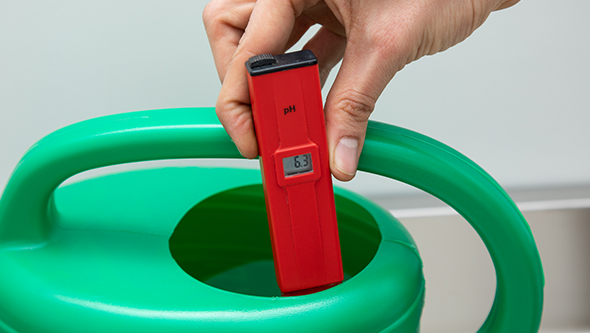
- Irrigation and runoff pH
- Type of substrate and growing medium
How to Tell the Difference Between Nutrient Toxicity, Lockout, and True Deficiencies
One of the most important lessons in advanced cannabis cultivation is understanding that yellowing leaves do not automatically mean nutrient deficiency, and burnt tips are not always caused by overfeeding. Correct diagnosis comes from evaluating all the signals together.
Nutrient Toxicity
Nutrient toxicity becomes likely when:
- The plant appears excessively dark green
- Leaf tips are burnt
- Leaves curl downward
- Runoff EC is high
- Symptoms worsen after increasing nutrient dosage
Nutrient Lockout (The Plant Cannot Absorb Available Nutrients)
- pH falls outside the correct range
- Salts accumulate in the substrate
- Deficiency symptoms appear despite regular feeding
- Growth slows without another obvious cause
True Nutrient Deficiency
A real deficiency becomes more likely when:
- EC remains low or moderate
- pH stays within range
- The plant improves after slightly increasing nutrients
- The symptom pattern matches a specific deficiency
One practical rule has saved countless growers from making the problem worse:
Measure before adding more nutrients.
If runoff EC is higher than input EC, adding more fertilizer is rarely the right move.
How to Fix Nutrient Toxicity Step by Step
- Stop feeding immediately: Temporarily stop fertilizing and avoid adding extra products “just in case.” In severe cases, additional nutrients usually make root-zone lockout even worse.
- Measure input and runoff EC and pH: Prepare irrigation water with adjusted pH and measure its EC. Water until runoff appears, then measure runoff EC and pH as well. If runoff EC comes out significantly higher than the incoming solution, salts have accumulated in the root zone. In coco and peat-based substrates, runoff readings do not always perfectly reflect root conditions, but they still provide valuable information.
- Flush the root zone: In soil or coco grows, flush with low-EC water adjusted to the proper pH. As a general guideline:
- 10 L pot → 20–30 L of water
- 7 L pot → 14–21 L of water
- 20 L pot → 40–60 L of water
The goal is not to drown the plant. The goal is to wash excess salts out of the substrate.
Allow the medium to drain fully afterward. Ideal pH ranges vary slightly depending on the substrate:
- Coco: around pH 5.8
- Soil: around pH 6.2–6.5
- Check runoff again: Measure runoff EC after flushing. There is no need to reduce EC to zero. A completely depleted substrate can leave the plant without available nutrition. The objective is simply to bring salinity back into a manageable range.
- Give the plant time to recover: After flushing, roots need oxygen. Avoid watering again while the substrate is still saturated. Damaged leaves usually will not recover, and that is completely normal. Focus on new growth instead. Healthy new shoots are the best sign that recovery is underway.
- Reintroduce nutrients gradually: Once vigorous growth returns, nutrients can be reintroduced progressively at moderate EC levels.
Nutrient toxicity in cannabis cultivation is not simply the result of “using too much fertilizer.” It is a complex imbalance involving salt accumulation, elevated EC, pH fluctuations, and nutrient antagonisms.
Burnt tips may be the most famous symptom, but accurate diagnosis requires evaluating the complete root-zone environment: dark foliage, clawing leaves, slowed growth, elevated runoff EC, and recent feeding history.
In cannabis cultivation, the line between proper feeding and overfertilization is extremely thin. The goal is not to push plants to their physiological limit, but to maintain a stable environment where nutrients remain available, roots stay healthy, and flowering progresses without stress. That is where growers achieve truly healthy, productive, high-quality harvests.