By mastering physiological mechanisms such as apical dominance and auxin flow, the grower transcends passive observation, becoming the architect of the harvest and sculpting the plant toward one ultimate goal: perfection in every bud.
To understand the purpose of pruning, we must first view the plant as an energy management system. In its natural state, cannabis tends to grow in a “Christmas tree” shape to maximize sunlight capture — a structure governed by apical dominance.
The upper meristem (the tip of the main stem) functions as a hormonal command center, releasing auxins that flow downward and inhibit the development of lateral branches. In a controlled environment, this natural hierarchy proves inefficient: the canopy gets all the light while the lower zones stay in the shade, producing flowers of lesser quality.
Through pruning, growers break the plant’s natural tyranny, redistributing resources so that every cola competes on fair ground.
Breaking the Hierarchy with Apical Pruning and FIM
The most fundamental intervention in cannabis architecture is the physical disruption of the main meristem. This practice branches into two distinct methodologies: the surgical precision of Topping (classic apical pruning) and the calculated unpredictability of FIM.
Topping involves the full removal of the terminal shoot, severing the main stem just above the chosen node.
The plant’s response is swift and predictable: removing the primary source of auxins lifts the inhibition on the axillary buds located just below the cut. The plant channels its energy and cytokinins (root-derived hormones that stimulate cell division) toward these lateral shoots, turning a single main cola into two new dominant stems.
This technique not only doubles the number of colas but also promotes a bushier, wider structure — ideal for maximizing light absorption in height-restricted spaces like indoor grows, particularly in grow tents where vertical space is limited.
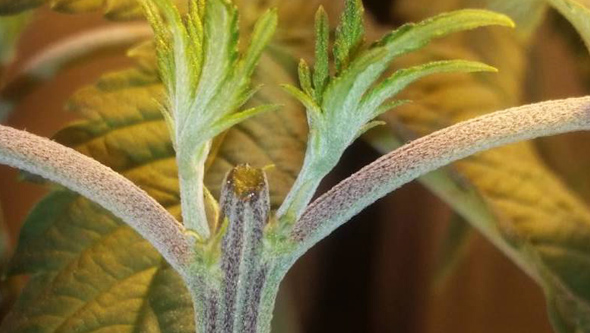
On the other hand, the FIM (“Fuck I Missed”) technique offers a less invasive yet more unpredictable approach. Instead of making a clean cut through the stem, about 75–80% of the new shoot tissue is removed, partially damaging the meristem without fully eliminating it.
In its effort to heal, the plant often produces not just two but four or more main shoots from the trauma site.
Although FIM is less stressful on the plant and allows faster recovery of vertical growth than Topping, its results are less consistent. Topping provides structural symmetry, while FIM delivers greater volume, making it particularly effective for strains that benefit from enhanced branching without sacrificing vertical development.
Mainlining: the Art of Symmetrical Pruning
For growers seeking maximum aesthetic and structural efficiency, Mainlining (or Manifolding) transforms pruning into a precise art. The goal is not simply to increase branching but to create identical “energy distributors” for each cola. The process starts with early apical pruning and the removal of lower growth, leaving only two main stems in a clean “Y” shape.
Through successive pruning sessions, the plant develops a structure where 8 or even 16 colas originate from the same central point in the vascular system. This uniformity ensures equal nutrient flow to each cola, reducing the formation of small “popcorn” buds and greatly simplifying post-harvest trimming.
Although recovery demands a longer growth phase, the result is a harvest marked by commercial-grade uniformity.
Managing Light and Biomass with Lollipopping and Defoliation
Once the plant’s structure is established, the next challenge lies in optimizing energy use during the flowering phase. Lollipopping and strategic defoliation address this by manipulating the plant’s source–sink relationship, ensuring resources flow where they are most productive.
Lollipopping tackles the challenges of light penetration and aeration. Because grow lights lose intensity exponentially with distance, the lower areas of the plant often consume more energy than they generate through photosynthesis.
By removing all growth from the lower third of the plant (leaving the stems bare like a lollipop stick), you force the plant to concentrate its limited resources on the upper canopy, where photosynthetic activity is at its peak.

This technique not only prevents the formation of airy “popcorn” buds but also improves air circulation, lowering the risk of pathogens like Botrytis in dense growing environments.
Defoliation, in contrast, is highly controversial. While purists argue that leaf removal reduces overall photosynthetic capacity, evidence from high-yield operations suggests that the strategic removal of large fan leaves that shade flower sites can increase the overall yield. Exposing developing buds to direct light promotes trichome production and denser floral growth.
At the most radical end of this practice is Schwazzing, a highly aggressive technique that involves stripping nearly all the leaves at two critical stages: day 1 of flowering, and again on day 21 (right after the stretch has finished).
Comparative grow data show that, when executed correctly within optimized systems, Schwazzing can significantly boost the plants’ yielding capacity. However, the risk of plant shock remains high if nutritional support isn’t precisely managed.
Beneficial Stress Techniques: Super Cropping and Monster Cropping
Beyond simple pruning lies controlled stress. When cannabis is subjected to a certain level of trauma, it activates natural defense mechanisms that strengthen its structure and boost resin production.
Super Cropping is a training technique where mature branches are carefully pinched and bent until the inner fibers give way, while the outer skin remains intact. The plant responds by repairing the injury with a thickened “knuckle” of reinforced tissue, which strengthens the branch and improves vascular conductivity for nutrient transport. Beyond height control, this controlled stress activates the plant’s defense systems, often leading to increased production of valuable secondary metabolites.
Monster Cropping is another advanced training method that toys with the plant’s internal clock. It consists of taking cuttings from a mother plant that’s already been flowering for several weeks and then reverting those clones back into a vegetative state.
The hormonal stress triggered by this process drives plants to grow with remarkable vigor, developing an extremely bushy, highly branched structure — hence the name “monster”. These clones are particularly well-suited for filling large grow spaces (such as SCROG setups), since they develop far more flowering sites than plants grown directly from seed.
Combining HST and LST for Masterful Synergy
Advanced cultivation relies on the integration of multiple training strategies rather than isolated techniques. This is where High Stress Training (HST), such as Topping or Mainlining, meets Low Stress Training (LST), creating a balanced approach that maximizes plant potential.
HST is used to establish the plant’s foundation by shaping its base structure and multiplying its colas. Because these cuts are traumatic, the plant requires time to recover. It is during this healing phase that LST comes into play: growers gently bend and tie the new branches outwards, expanding the canopy horizontally without adding further stress.
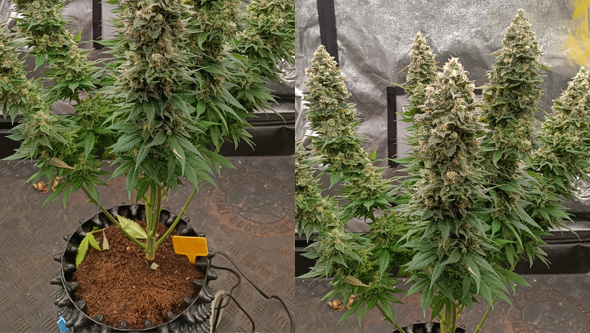
By combining HST and LST, growers can achieve a uniform, flat canopy where every cola receives equal light exposure. The ultimate example of this synergy is the SCROG (Screen of Green) technique, in which a net is used to guide the branches through LST after the plant’s structure has already been shaped by HST.
By combining the cola multiplication achieved through Topping with the horizontal distribution provided by LST, growers maximize photosynthetic efficiency across every square meter. This synergy produces yields that surpass what either technique could accomplish alone.
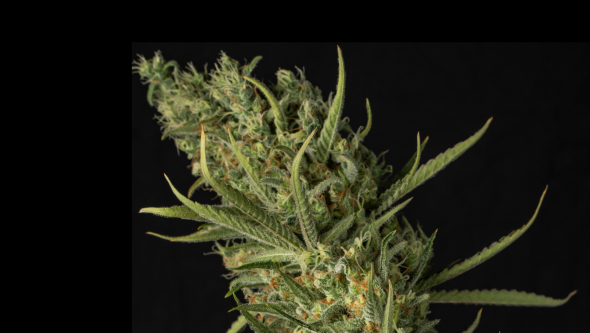
A Different Approach for Each Strain
When applying training techniques, it is essential to distinguish between photo-dependent feminized seeds and autoflowering varieties. Autoflowering strains (which carry Ruderalis genetics) follow a fixed internal clock that limits their life cycle to roughly 60–90 days. Because of this shortened timeline, they lack the recovery window needed to recover from high-impact stress.
As a result, techniques like Mainlining or aggressive defoliation applied to autoflowering plants often leads to stunted growth and reduced yields.
This is a good example of how mastering cannabis pruning and training techniques is ultimately an exercise in balance. It requires attentiveness to the plant’s signals, an understanding of its genetic profile, and the application of the right technique at the right physiological stage. Whether through symmetrical canopy design or intensive biomass management, the goal remains constant: to convert light and nutrients into the plant’s fullest floral expression.